

What is a captive agent?
A captive agent represents a single insurance company. You see them in every city: one national brand on the door, one lineup of products to offer. Because they work exclusively with one company, captive agents usually know its policies in detail and can walk you through that brand's discounts and bundles quickly.
That's a real strength for some insurance buyers. If you trust a particular brand, want home and auto under one roof, or prefer one simple relationship, a captive agent fits. The limit is that everything they can offer comes from one company.
What is an independent agent?
An independent agent isn't tied to one company. They work with several insurers—Openly among them—and compare those options for you. Instead of fitting your home into one company's box, independent agents shop it across carriers to find coverage that matches it.
Independent agents are how a large share of people buy coverage. They placed about 40% of personal lines premiums such as home and auto in the US in 2025, and 62% of all property and casualty premiums overall, according to the Independent Insurance Agents & Brokers of America 2026 Market Share Report.
That structure changes who the agent works for. An independent agent answers to you, not to a single brand. Many independent agents live and work in the communities they serve, so they have a deep knowledge of local risks, and they typically stay involved for renewals, coverage questions, and claims.
For more, see why homeowners choose an independent insurance agent.
Captive vs. independent agent: what are the key differences?
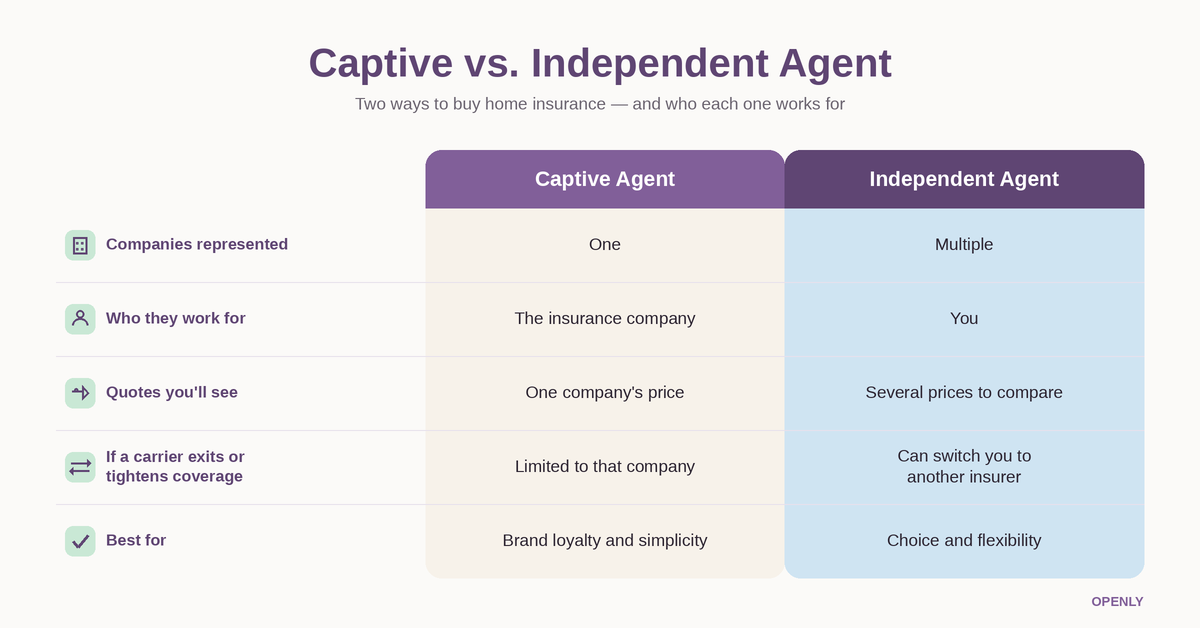
Both models can give you attentive service. The main difference comes down to choice. A captive agent sells one company's policies, while an independent agent compares several insurers and represents you rather than a brand. That shapes how many quotes you see, what happens if a carrier pulls out of your market, and who your agent ultimately answers to.
Here's how the two compare across the factors that matter most:
How does my choice of agent affect my coverage and premium?
An independent agent compares the products and benefits of more than one insurer, so they can match coverage to your home instead of to a single company's appetite. That option of choice matters most when your home isn't average, like an older house, a high-value build, a property with additional features like a pool, or even a second home.
Choice of independent vs captive agent affects price, too. Shopping several insurers means you can see more than one number before you decide on an insurance policy and provider. This doesn’t guarantee the lowest price for insurance, but it does provide more information to weigh against the coverage you're getting.
For an example of what an insurance policy sold through independent insurance agents can provide you, review the options Openly offers on our home insurance coverage page.
How do I decide which type of agent is right for me?
To decide which type of agent is right for you, begin by comparing the policies themselves, and not simply the premium. When you talk to any agent, look at these four things:
- Deductible—the amount you pay out of pocket before coverage kicks in. A lower premium often means a higher deductible.
- Replacement cost basis—whether the policy pays to rebuild at today's construction costs (replacement cost) or pays the depreciated value of your home and belongings (actual cash value). Replacement cost pays more after a covered loss.
- Endorsements—add-ons that extend a standard policy, such as water backup, cyber coverage, or extended coverage for jewelry and other valuables.
- Coverage limits—the maximum the policy will pay for your dwelling, belongings, and liability.
It’s also worth asking the insurance agent specific questions like: How many and which insurers can you quote me? What's covered under this policy that a standard one wouldn't cover? What happens to my rate at renewal? What would you do if my carrier stopped writing in my state?
It may be time to talk to an independent agent if your premium jumped at renewal, your insurer stopped offering coverage where you live, or your home changed in a way a standard policy wasn't built for. In states where rates are climbing or insurers are pulling back, having someone who can compare carriers is especially useful. When you're ready, you can find an independent agent near you.
Why does Openly work only with independent agents?
Openly policies are sold through independent agents. We offer an enhanced HO-5 policy, the most comprehensive standard homeowners form, with up to $5 million in Guaranteed Replacement Cost coverage (which pays to rebuild your home even if costs exceed your policy limit) and liability coverage up to $1 million.
Openly's carrier partner is rated A- (Excellent) by AM Best, which speaks to the financial strength behind your coverage. We're currently available in 24 states and expanding. And if you ever need to file a claim, your independent agent and our home insurance claims team are there to help.
The bottom line
Choosing between an independent and a captive agent comes down to one question: how much choice do you want guiding your home insurance? A captive agent gives you depth in one brand. An independent agent gives you breadth, an advocate, and the ability to adapt as your needs and the market change.
Find a local independent agent to talk through your options.
FAQ