
The Pacific Northwest is an incredibly beautiful and diverse geographical region. From rugged coastlines, to the peaks of the Cascades and the high desert eastern plains, the region's natural splendor, vibrant yet community-focused cities, and mild climate make it an appealing place for an increasing number to call home.
With a temperate climate but geographically varied terrain, the Pacific Northwest presents a number of unique property risks that may require specific insurance considerations. Standard homeowner policies frequently exclude or inadequately cover region-specific perils, leaving homeowners exposed to significant financial loss.
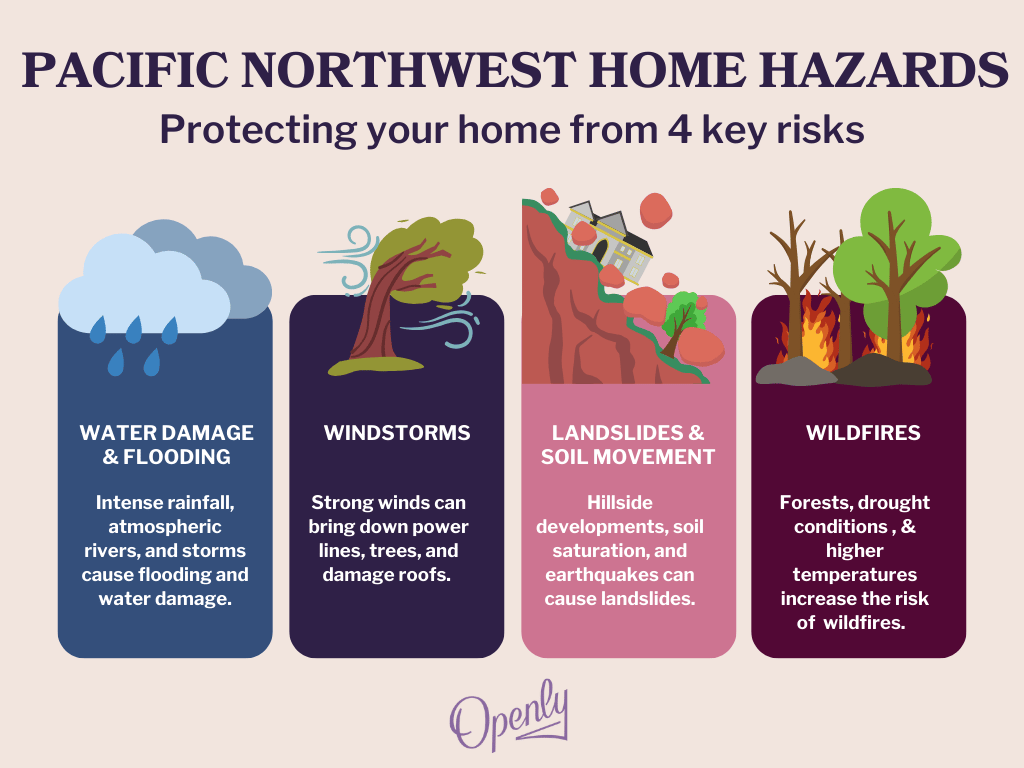
Water damage and flooding
The Pacific Northwest (“PNW”) is famous for rain, and the PNW experiences its fair share of several types of flood risks, including flash floods, saturated soil, storm surges, and more.
When heavy rains over-saturate soil, flash flooding can occur in areas with steep terrain. King tides and storm surges regularly threaten coastal properties. Meanwhile, atmospheric rivers—long plumes of moisture from the Pacific, including the Pineapple Express—can dump over 10 inches of rain in a short span of time1, overwhelming urban drainage systems and triggering hillside instability, resulting in over $1 billion in damage annually.2
What homeowners should know about water damage and flooding
- Standard homeowners insurance doesn’t cover flooding from external water sources. This means that if a nearby river overflows, stormwater backs up through drainage systems, or king tides hit coastal towns, a separate flood insurance policy is recommended for adequate protection.
- Standard home insurance policies typically cover water damage from internal sources such as burst pipes or roof leaks.
- Many homes in the Pacific Northwest have basements, and sump pumps are common. Consider backup power for your sump pump and understand whether your policy covers sump pump failure. Some insurance providers, like Openly, offer coverage or endorsements specifically for water backup or sump pump damage.
Wildfires
Wildfire risk in the Pacific Northwest has escalated in recent years. In 2024, Oregon saw its worst wildfire season on record, with more than 1.9 million acres burned and costing $142.7 million in residential fire loss. Rising temperatures have contributed to increased drought conditions and longer fire seasons.3
What homeowners should know about wildfire risk
- Homeowners insurance typically covers fire damage, but some insurance providers may have limited exposure in fire-prone regions or require specific mitigation measures before offering coverage.
- Creating defensible space is essential for helping prevent wildfires from spreading. Removing dead vegetation and leaves from your roof and gutters, trimming tree branches that overhang your home, and maintaining a buffer zone of reduced vegetation around your property can all help reduce the risk of wildfire damage to your home.
- Homes with wood shake roofs, vinyl siding, or wood fencing attached to the dwelling may face higher risk. When renovating, opt for fire-resistant materials like metal or asphalt roofing, fiber cement siding, and non-combustible decking to mitigate your home’s risk of fire damage.
-
Safety is the top priority and as such it's important to have an evacuation plan and maintain a go- bag with important documents, medications, and other essentials like water. If you're required to evacuate, your insurance policy may cover additional living expenses while you're displaced, but understanding the limits and requirements of this coverage beforehand is important.
Windstorms
The Pacific Northwest can experience strong windstorms, especially during the fall and winter months, with wind gusts downing trees, damaging roofs, and knocking out power.
The region's abundant trees and forests, while beautiful, can become home hazards during windstorms. Falling trees and branches cause extensive property damage, block roads, and create dangerous conditions, while saturated soil from heavy rain adds to the risk of toppling during wind events.
What homeowners should know about wind damage
- Wind damage is typically covered under your standard homeowners policy, but prevention is key. Regularly inspect trees on your property for signs of disease, decay, or instability. Remove dead trees and trim branches that could reach your home if they fall.
- After major windstorms, carefully inspect your property for damage. Look for missing or lifted shingles, dented gutters, damaged siding, and check your roof for punctures from fallen branches. Even minor roof damage can lead to water intrusion and other serious problems if not addressed.
- Document wind damage thoroughly with photos and videos before making temporary repairs.
Landslides and soil movement
The Pacific Northwest's unique and varied topography creates a risk of landslides, particularly in areas with heavy hillside development. Heavy rains can make soil unstable, and earthquakes (more on that later) can trigger landslides. Even wildfire-burned areas face an increased landslide risk after the vegetation that once stabilized the slopes is gone.
What homeowners should know about earth movements
- Many standard homeowners policies exclude damage from earth movement, including landslides and mudflows.
- Separate landslide or earth movement insurance is available but can be expensive. If you're considering purchasing a hillside property, you should factor in the cost of earthquake insurance.
- Look for warning signs of earth movements, like cracks in walls or foundations, sticky doors or windows, leaning trees or fences, and any new gaps around exterior features. These could indicate soil movement and require a professional assessment.
Earthquakes
Many homeowners assume earthquakes are primarily a California concern—but that is a misconception. The Cascadia Subduction Zone, which runs all the way from Northern California up to British Columbia, can produce catastrophic earthquakes. In addition, the Seattle Fault, Portland Hills Fault, and several other fault lines crisscross the Pacific Northwest region.
In 2024, 3,272 earthquakes were recorded across the Pacific Northwest. Geological studies indicate that major seismic events occur every 300-600 years.4 With the biggest earthquake in North American history—a 9.0 on the Richter scale—occurring in the Pacific Northwest 326 years ago5, scientists warn that a major Cascadia earthquake has a 16-22% chance of occurring in the next 50 years.6
What homeowners should know about earthquake risk
- Standard homeowners insurance does not cover earthquake damage. To ensure coverage against earthquake damage, homeowners need a separate earthquake insurance policy or endorsement. Earthquake insurance can be expensive, but the potential for catastrophic loss makes it worth serious consideration, especially if your home is located on a hill or steep terrain.
- When considering earthquake coverage, it's critical that you pay extra attention to the policy’s deductible for that risk. If your home is insured for $500,000 and your deductible is 15%, you would be responsible for the first $75,000 of damage out-of-pocket. Despite this, the amount is still less than the cost to replace your home in full in the event of a devastating earthquake.
- If your home is on the older side, you may want to consider retrofitting to improve earthquake resistance. Foundation bolting, cripple wall bracing, and securing water heaters can help reduce damage.
Volcanic activity
Volcanic eruptions may seem like something out of the history books or science fiction, but the Cascade Range includes over 10 active volcanoes, including Mount Rainier, Mount Hood, and Mount St. Helens. While eruptions are rare, they present real risks ranging from ash-fall and volcanic mudflows to pyroclastic flows, in worst-case scenarios.
What homeowners should know about volcanic activity
- Standard policies might cover ash damage to your home but could exclude certain volcanic-related perils. Because this is such a rare event, policies vary significantly in their treatment of volcanic hazards and it's important to understand your policy’s coverage for such events.
- The biggest concern isn’t lava; it's the secondary effects, such as ash-fall damaging HVAC systems and mudflows destroying properties. Volcanoes located in the Cascade Range also pose ash fall and debris flow risks to surrounding communities. Ash damage typically falls under standard dwelling coverage, but volcanic flood and mudflow events require additional coverage.
Taking action to protect your Pacific Northwest home
The Pacific Northwest's unique geography has both its appeal and its challenges, and protecting your home requires understanding regional hazards and standard policy limitations. Take time to review your current coverage, assess your home's specific risks, and have honest conversations with insurance professionals who understand the Pacific Northwest. Your home is likely your most significant investment—protecting it properly is one of the most important decisions you'll make.
At Openly, we're committed to helping homeowners protect their homes and achieve peace of mind. The right home insurance policy is about ensuring that whatever nature brings, you and your family can recover and rebuild. Visit Openly.com to learn about our enhanced HO-5 home insurance policy, find a local independent agent, or get a quote.
We provide this information to help you understand insurance. Any coverage is subject to the terms of your policy. Please refer to your policy and declarations page for complete terms, conditions, exclusions and coverage details. Openly may provide links that lead to an external website that may promote goods and services that Openly does not endorse. We are not responsible for the content, claims, or representations made on the linked website. Please review their terms and policies before engaging with any offerings.
1 NASA. “Pacific Moisture Drenches the U.S. Northwest.” Published 12 December 2025. Accessed 29 January 2026. https://science.nasa.gov/earth/earth-observatory/pacific-moisture-drenches-the-u-s-northwest/
2 Climate Hubs. “Atmospheric Rivers in the Northwest.” USDA. Accessed 29 January 2026. https://www.climatehubs.usda.gov/hubs/northwest/topic/atmospheric-rivers-northwest
3 Oregon State Fire Marshall. “2024 Annual Report.” Oregon.gov. Published March 2025. Accessed 29 January 2026. https://www.oregon.gov/osfm/about-us/Documents/FINAL_2024_Annual_Report.pdf
4 Pacific Northwest Seismic Network. “2024 PNSN Earthquake Catalogue.” PNSN. Published 2025. Accessed 29 January 2026. https://pnsn.org/blog/2024-pnsn-earthquake-catalog
5 Erin A. Wirth, et al. “Earthquake Probabilities and Hazards in the U.S. Pacific Northwest.” USGS.gov. Published 19 September 2025. Accessed 20 April 2026. https://pubs.usgs.gov/publication/fs20253050/full
6 Meredith Moran. “Pacific Northwest Counties Prepare for ‘The Big One’.” National Association of Counties. Published 20 August 2025. Accessed 29 January 2026. https://www.naco.org/news/pacific-northwest-counties-prepare-big-one