
The Southeast, encompassing states from Florida to the Carolinas and extending inland to Tennessee and Alabama, is one of the most beautiful and geographically varied regions of the country. But it's also a region that faces a year-round gauntlet of wind, water, humidity, and fire, making its home insurance market one of the most volatile and expensive in the nation.
Hurricanes and tropical cyclones
Hurricane season runs from June 1 through November 30, and it is one of the single greatest drivers of insurance rates in the Southeast. But many homeowners discover the most important details of their hurricane coverage only after a storm has already made landfall—which is exactly the wrong time to learn them.
Wind damage
Wind damage is typically covered under a standard homeowners policy, but with a critical caveat for coastal residents: the Hurricane Deductible. Unlike a flat dollar deductible, hurricane deductibles are calculated as a percentage of your home’s total insured value—commonly between 1% and 5%. On a home insured for $500,000, a 5% deductible means you are responsible for the first $25,000 in repair costs before your coverage begins.
Flood and storm surge
Standard homeowners insurance does not cover flooding of any kind—including storm surge, which is the wall of seawater pushed inland by a hurricane’s winds. Storm surge, not wind, is responsible for the majority of hurricane-related property losses in coastal states.
Without a separate flood policy through the National Flood Insurance Program (NFIP) or a private flood carrier, a homeowner in the storm surge zone is effectively self-insuring against the most common and most catastrophic form of hurricane damage.
Severe convective storms
You do not need to live on the coast to face serious storm risk in the Southeast. A swath of inland states, from northern Alabama and Georgia through Tennessee and into the Carolinas, falls within what meteorologists call “Dixie Alley,” a region with a frequency of violent tornado activity that rivals the Tornado Alley of the Great Plains.
Tornadoes
Unlike the flat, open terrain of the Midwest, where tornadoes are often visible from miles away, the Southeast’s hilly, forested landscape can conceal a rotating storm until it is immediately overhead. Warning times are shorter, damage paths are less predictable, and the potential for a complete dwelling loss is significant.
Replacement Cost coverage, not Actual Cash Value, is essential: it pays to rebuild your home to its prior condition, rather than paying what a depreciated structure was deemed to be worth.
Hail
Hail is often described as a “silent” hazard because the damage it inflicts is not always immediately visible. A hailstorm may not break windows or dent gutters dramatically, but it can bruise and damage asphalt roof shingles in ways that compromise their waterproofing integrity. Over time, those micro-fractures may allow water to infiltrate the roof deck, the attic insulation, and eventually the structural framing—turning a single storm event into an ongoing and worsening loss.
Lightning
Beyond the direct risk of fire, a nearby lightning strike can induce a power surge capable of destroying every connected electronic system in a home simultaneously: HVAC units, smart home devices, kitchen appliances, televisions, and networking equipment. Equipment Breakdown coverage and a whole-home surge protection endorsement are worth evaluating if you live in a high-lightning-frequency area.
Water and moisture intrusion
In the Southeast, moisture is a year-round adversary, not just a storm-season concern. The region’s legendary subtropical humidity creates conditions where minor water intrusion events can escalate rapidly into significant structural and health hazards.
Mold
Mold doesn't wait. In the Southeast’s heat and humidity, a few missing shingles or a broken window seal can allow enough moisture into an attic or wall cavity to trigger active mold growth within 24 to 48 hours. The problem is that many standard homeowners policies don’t cover old growth, although coverage can be provided (with potential limitation) via an endorsement.
Water seepage
The Southeast receives significant seasonal rainfall, and in low-lying areas or properties with clay-heavy soil, that rain doesn’t drain quickly. Water from over-saturated earth can drive water into basements or crawlspaces in ways that standard policies typically classify as “seepage” or “groundwater intrusion,” both of which are typically excluded from standard policies. Homeowners in at-risk areas should investigate water backup endorsements and / or flood coverage that extends to below-grade water intrusion.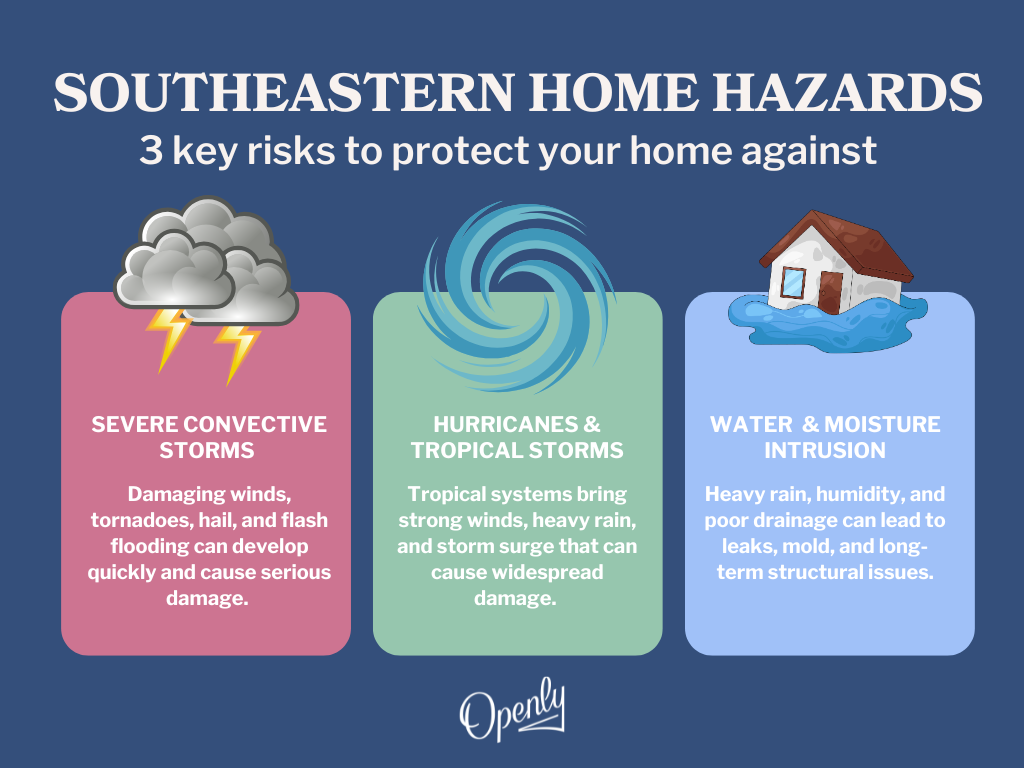
The bottom line
The Southeast rewards homeowners who take preparation seriously and penalizes those who do not. The gap between a homeowner who recovers from a major storm within a year and one who faces financial ruin from the same event is rarely luck—it is almost always a function of coverage decisions made months or years in advance.
Review your policy before the season begins. Fill the flood insurance gap. Determine if your policy has coverage for mold and / or if you should consider covering mold through an endorsement. Add Extended Replacement Cost. These are not upsells—they are the difference between rebuilding your home and starting over from nothing.
If you have questions about whether your current coverage is adequate for the risks specific to your property and location, speak with a licensed independent insurance agent who knows your market. The time to have that conversation is now.
*We provide this information to help you understand insurance. Any coverage is subject to the terms of your policy. Please refer to your policy and declarations page for complete terms, conditions, exclusions and coverage details. Openly may provide links that lead to an external website that may promote goods and services that Openly does not endorse. We are not responsible for the content, claims, or representations made on the linked website. Please review their terms and policies before engaging with any offerings.